Plus, with no employees, there’s no one with a paycheck.
No paychecks mean no customers.
We think billionaires spend lots, but they don’t. Jeff Bezos buying a support yacht for his megayacht every ten years doesn’t support an entire country’s GDP.
Its those with the least to spend who are the actual job creators. They spend every penny they earn (and then some) because they have to in order to survive.
This might actually be an intended side effect. Eroding the tax base of countries and income of other businesses ensures that everyone is dependent on the tech corpos, enabling blackmail on nation states and buying up everything under the sun.
I am still not sure if our high-tech neo-feudalism will consist of nation states using corpos in proxy wars or out of corpos puppeteering nation states.
That’s never been a concern with the corporate executives. The macro level stuff is someone else’s problem.
We saw it in the 90’s when they stopped hiring managers from within, instead relying on bringing in outside consultants, and then directly hiring the ones they liked, so that there was no longer a path between the typical employee’s seat and their boss’s seat.
We saw it in the 2000’s when companies realized that they didn’t want to train entry level employees anymore, and would rather wait for someone else to train them, and then hire midlevels. Except too many employers did that and then the pipeline of future midlevels dried up in a lot of industries that were then ill positioned to survive the tumult of the 2008-2010 recession. Then something similar played out in the 2010s in certain other industries.
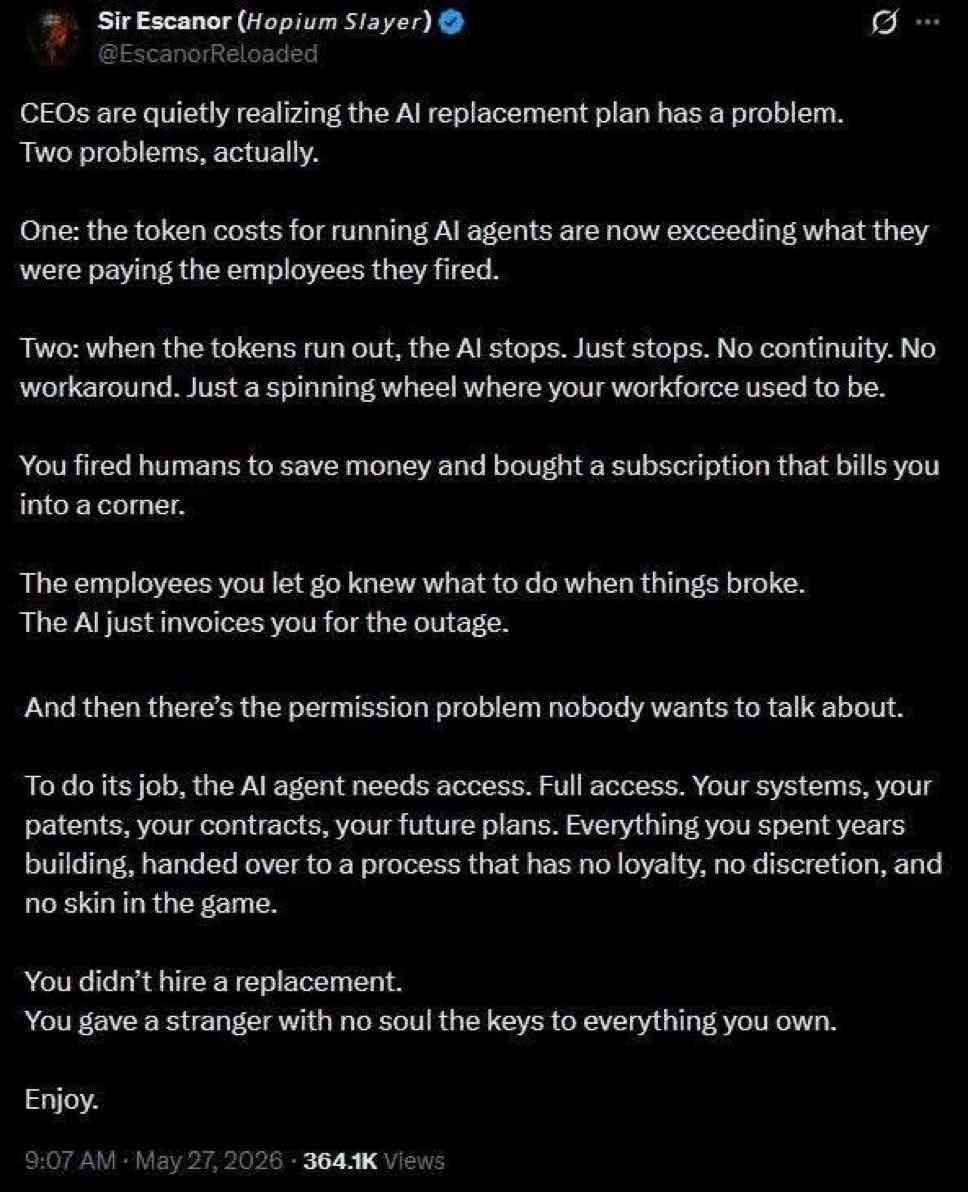
Token costs and the permission problem cost the company itself, while eliminating paychecks is a negative externality. 99% of the paychecks that fund their business come from other businesses.

Plus, with no employees, there’s no one with a paycheck.
No paychecks mean no customers.
We think billionaires spend lots, but they don’t. Jeff Bezos buying a support yacht for his megayacht every ten years doesn’t support an entire country’s GDP.
Its those with the least to spend who are the actual job creators. They spend every penny they earn (and then some) because they have to in order to survive.
This might actually be an intended side effect. Eroding the tax base of countries and income of other businesses ensures that everyone is dependent on the tech corpos, enabling blackmail on nation states and buying up everything under the sun.
I am still not sure if our high-tech neo-feudalism will consist of nation states using corpos in proxy wars or out of corpos puppeteering nation states.
My predictions favour Snow Crash style Corpocratic Balkanisation.
The East India Company will rise again, a new age of private armies rivalling those of nation states is upon us!
That’s never been a concern with the corporate executives. The macro level stuff is someone else’s problem.
We saw it in the 90’s when they stopped hiring managers from within, instead relying on bringing in outside consultants, and then directly hiring the ones they liked, so that there was no longer a path between the typical employee’s seat and their boss’s seat.
We saw it in the 2000’s when companies realized that they didn’t want to train entry level employees anymore, and would rather wait for someone else to train them, and then hire midlevels. Except too many employers did that and then the pipeline of future midlevels dried up in a lot of industries that were then ill positioned to survive the tumult of the 2008-2010 recession. Then something similar played out in the 2010s in certain other industries.
It’s always been buck passing. They don’t care.
Token costs and the permission problem cost the company itself, while eliminating paychecks is a negative externality. 99% of the paychecks that fund their business come from other businesses.