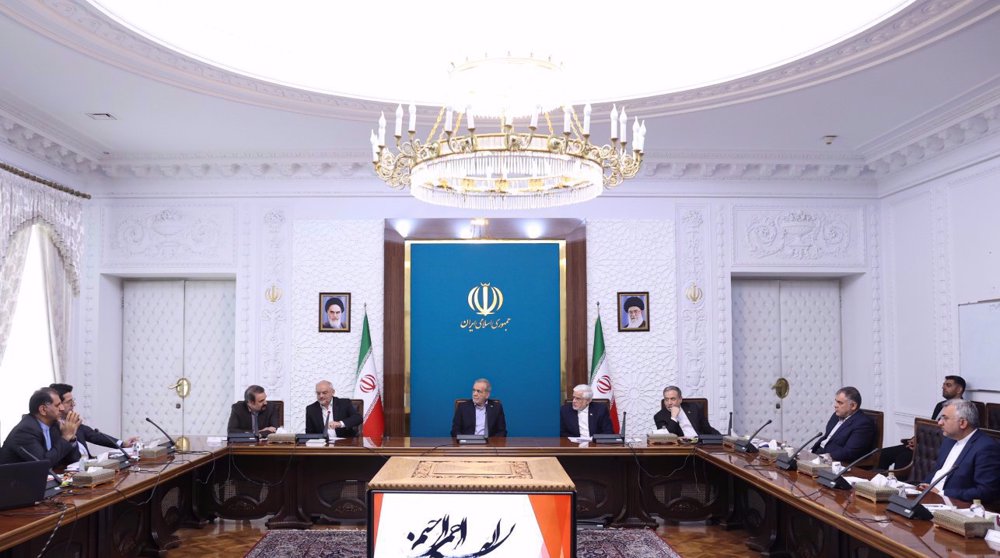
President Masoud Pezeshkian has voiced Iran’s readiness for “serious and constructive” cooperation with China, particularly within the framework of Beijing’s Belt and Road Initiative (BRI), ahead of his planned visit to China later this month.
Everyone reading this thread should fucking read Losurdo’s Class Struggle. China’s proletarian party is working in the long term interests of the proletariat by allowing bourgeois management of the economy and slowly learning from and then replacing it. But applying the Unity of Action principle means also letting specific models succes and fail of their own accords after attempting to apply them well. And right now, the economic model is working and being slightly shifted where needed, but achieving the long term goals. If China were to give all this up, and attack and then be destroyed by the imperialist west to stop the current atrocities (as much as I care about it too), the genocides that would follow would be even larger and worse. I’m not starry eyed enough to think China would actually win a global war right now, because the enemy is genuinely very powerful.
Stalin wanted to win in Spain but knew that destroying themselves there would prevent their survival in the coming war. It’s a fundamentally future and empirically oriented position, and that feels horrible and harsh at any given moment of inability.
Definitionally, China’s economy fits fully into the neoliberal framework and adheres closely to the IMF prescription (balancing the budget, export-led growth, privatization etc.). Please don’t say just because China has industrial policy that it is not neoliberal. Many countries, including Japan and South Korea, have industrial policies and still fit fully into the neoliberal framework.
From an academic standpoint, economics departments across Chinese academia are already dominated by Western neoclassical and Austrian school economists who studied in Western universities. You want to find Marxist economists? They’ve all been banished to the humanities and social sciences departments decades ago.
From a historical standpoint, China’s reform and opening up model was designed by the Chicago school and Milton Friedman was even invited twice to China to educate Chinese policymakers. Shanghai’s financial sector was designed by the Chicago school lol.
Perhaps the most prominent economist and policy advisor in China today, Justin Lin Yifu, who pioneered the New Structural Economics that defined the Chinese economic model for the past 30 years, was the first ever Chinese PhD graduate from the Chicago school of economics and the protege of Theodore Schultz himself, the co-founder of Chicago school of neoclassical economics together with Milton Friedman.
Again, you are confusing a country having industrial policy and some level of capital control, which I remind you, that exist in many countries in the world today, as being not neoliberal.
Again, you are confusing a country having industrial policy and some level of capital control, which I remind you, that exist in many countries in the world today, as being not neoliberal.
No, I’m talking about a country where the biggest companies and the banking sector and land are owned by the state. I’m talking about a country like this:
State-owned enterprises accounted for over 60% of China’s market capitalization in 2019[4] and estimates suggest that they generated about 23-28% of China’s GDP in 2017 and employ between 5% and 16% of the workforce.
Neoliberalism is first and foremost about privatization. After that it is about deregulation. It is not about the college an economic advisor went to or who their professor was a student of. None of the processes that have historically defined neoliberalism are dominant in the actual Chinese economy. China’s economy is probably the least neoliberal on earth outside of the other four ML states.
“SOE” is an economist weasel word, it covers everything from a soviet factory to a public corp handling contracts for 90% privatized services in post soviet countries. there isn’t even a percent of public ownership that makes an SOE an SOE.
Not saying Chinese SOEs function a specific way, but simply having them doesn’t pass muster imo, we need to interrogate the characteristics of them to actually know if they’re neoliberal or not.

really wish you would stop using this wildly inappropriate term for China, it’s like your definition of neoliberal comes from an alternate universe
Everyone reading this thread should fucking read Losurdo’s Class Struggle. China’s proletarian party is working in the long term interests of the proletariat by allowing bourgeois management of the economy and slowly learning from and then replacing it. But applying the Unity of Action principle means also letting specific models succes and fail of their own accords after attempting to apply them well. And right now, the economic model is working and being slightly shifted where needed, but achieving the long term goals. If China were to give all this up, and attack and then be destroyed by the imperialist west to stop the current atrocities (as much as I care about it too), the genocides that would follow would be even larger and worse. I’m not starry eyed enough to think China would actually win a global war right now, because the enemy is genuinely very powerful.
Stalin wanted to win in Spain but knew that destroying themselves there would prevent their survival in the coming war. It’s a fundamentally future and empirically oriented position, and that feels horrible and harsh at any given moment of inability.
Can you explain how is it inappropriate?
Definitionally, China’s economy fits fully into the neoliberal framework and adheres closely to the IMF prescription (balancing the budget, export-led growth, privatization etc.). Please don’t say just because China has industrial policy that it is not neoliberal. Many countries, including Japan and South Korea, have industrial policies and still fit fully into the neoliberal framework.
From an academic standpoint, economics departments across Chinese academia are already dominated by Western neoclassical and Austrian school economists who studied in Western universities. You want to find Marxist economists? They’ve all been banished to the humanities and social sciences departments decades ago.
From a historical standpoint, China’s reform and opening up model was designed by the Chicago school and Milton Friedman was even invited twice to China to educate Chinese policymakers. Shanghai’s financial sector was designed by the Chicago school lol.
Perhaps the most prominent economist and policy advisor in China today, Justin Lin Yifu, who pioneered the New Structural Economics that defined the Chinese economic model for the past 30 years, was the first ever Chinese PhD graduate from the Chicago school of economics and the protege of Theodore Schultz himself, the co-founder of Chicago school of neoclassical economics together with Milton Friedman.
Again, you are confusing a country having industrial policy and some level of capital control, which I remind you, that exist in many countries in the world today, as being not neoliberal.
No, I’m talking about a country where the biggest companies and the banking sector and land are owned by the state. I’m talking about a country like this:
Neoliberalism is first and foremost about privatization. After that it is about deregulation. It is not about the college an economic advisor went to or who their professor was a student of. None of the processes that have historically defined neoliberalism are dominant in the actual Chinese economy. China’s economy is probably the least neoliberal on earth outside of the other four ML states.
“SOE” is an economist weasel word, it covers everything from a soviet factory to a public corp handling contracts for 90% privatized services in post soviet countries. there isn’t even a percent of public ownership that makes an SOE an SOE.
Not saying Chinese SOEs function a specific way, but simply having them doesn’t pass muster imo, we need to interrogate the characteristics of them to actually know if they’re neoliberal or not.